
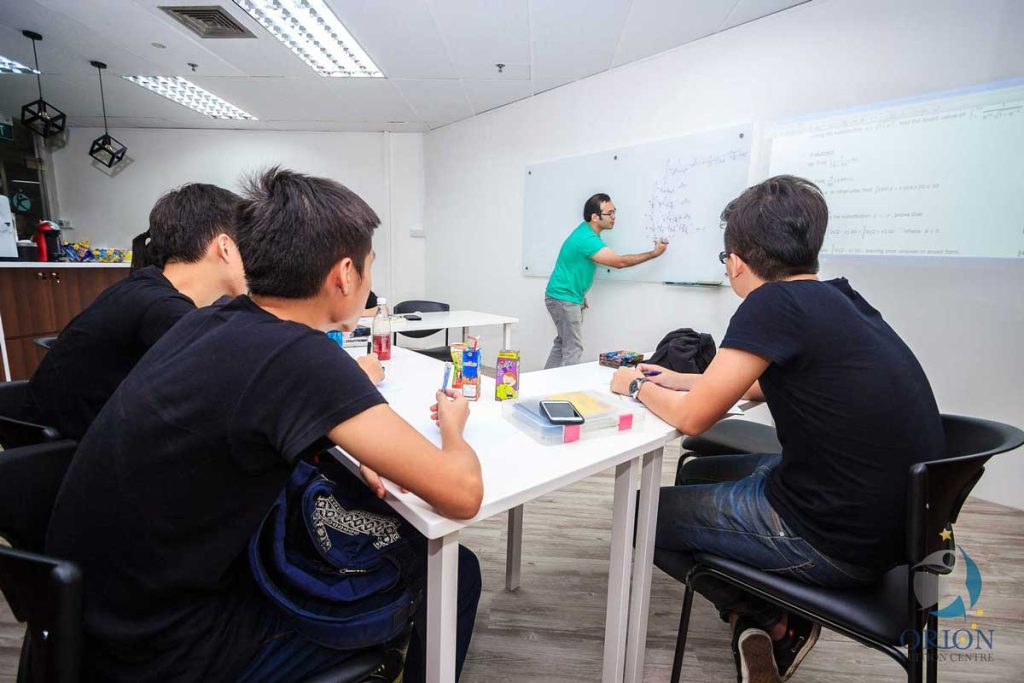
The transition from secondary school to Junior College is one of the most challenging academic hurdles a student will face in Singapore. Many students who comfortably secured a distinction in their O Level science subjects are shocked when they receive their first failing grade in H2 Physics. This sudden drop in performance happens because the A Level syllabus does not simply add new topics; it completely rewrites the mathematical and conceptual language of the subject. For parents looking for the Best Physics Tuition Bukit Timah, finding an educator who understands this severe transitional gap is essential.
Many JC students attempt to survive their first year by relying on the memorisation techniques that worked in secondary school. However, H2 Physics demands an advanced level of vector mathematics and abstract reasoning that rote learning cannot provide. A specialist provider like TGC ACADEMY recognises that upper secondary foundations must be actively deconstructed and upgraded. By focusing heavily on bridging these conceptual gaps early in the year, targeted tuition ensures students are fully equipped to handle the rigorous demands of the A Level syllabus.
Why the H2 Physics Transition is Challenging
In lower and upper secondary school, physics is largely taught in a single dimension. Students calculate objects moving in straight lines, forces pushing in parallel directions, and simple circuits that obey basic rules. The mathematics is generally limited to basic algebra.
In Junior College, physics immediately becomes two-dimensional and three-dimensional. The introduction to vectors in the very first weeks of the H2 syllabus fundamentally alters how students must approach problems. They can no longer simply add or subtract numbers. They must resolve forces into horizontal and vertical components using trigonometry. If a student is placed into a JC located near the Upper Bukit Timah or Beauty World area and expects the physics curriculum to be a gentle continuation of their previous year, they will be caught off guard by the sheer volume of mathematical modelling required.
The Hidden Gaps from Secondary School
The most significant gap students face is the application of kinematics. In O Level Physics, students use the equations of motion (like v = u + at) for straightforward scenarios, such as a car accelerating on a straight road.
In H2 Physics, students are immediately introduced to projectile motion. They must apply the equations of motion to both the horizontal and vertical axes simultaneously. A common conceptual error occurs when students fail to realise that horizontal velocity remains constant in a vacuum, while vertical velocity is constantly altered by gravity. Students with weak foundational logic will try to combine these separate components into a single, incorrect calculation.
Another hidden gap lies in the understanding of forces. Secondary students are used to dealing with blocks resting on flat tables. H2 students are expected to analyse blocks resting on inclined planes, suspended by multiple tension strings at various angles. If they have never truly understood how to draw a precise free-body diagram, they will be completely unable to resolve the forces required to determine if the system is in static equilibrium.
How the Syllabus Shifts in Junior College
The SEAB H2 Physics syllabus requires students to integrate topics effortlessly. Examiners do not test topics in isolation. A standard Paper 3 free-response question might begin with a scenario involving the collision of two charged particles.
To solve this, the student must first use the principles of electrostatics to find the force between the particles. They must then use kinematics to determine their acceleration, and finally use the principle of conservation of momentum to find their final velocities. This requires a level of mental agility that most incoming JC students have not yet developed. Furthermore, the explanation questions in the A Level exams are far more stringent. Students must construct logical arguments using highly specific scientific terminology, and any deviation from the accepted phrasing will result in a loss of marks.
The Importance of a Structured Bridging Approach
A premium tuition programme does not rush into advanced A Level topics without first checking the foundation. Expert tutors spend the crucial first few weeks of the JC1 year strictly reviewing and upgrading a student’s core mechanics skills.
During lessons, tutors actively train students in vector resolution. They drill the concepts of sine and cosine until resolving a slanted force becomes second nature. They also introduce students to the strict conventions of H2 graph drawing and error analysis, which are critical for the practical paper. By forcing students to abandon their simplistic lower secondary habits and adopt a rigorous, mathematical approach to problem solving, the tutor builds a resilient framework that can support the heavy cognitive load of later chapters.
Why TGC Academy is Relevant
Guiding students through this difficult transition requires educators who are deeply familiar with both the O Level and A Level curriculums. TGC ACADEMY builds its JC bridging programmes specifically to upgrade a student’s analytical toolset.
Their specialist tutors understand that students traveling from areas like King Albert Park and Clementi require highly efficient lessons that do not waste time on basic recaps. Instead, classes are focused on exposing the mathematical nuances of H2 Physics. Tutors provide proprietary summary materials that clearly map how simple secondary school concepts evolve into complex A Level theories. By providing a structured, step-by-step approach to vector mechanics and integrated problem solving, students develop the confidence to tackle their JC promotional exams without feeling overwhelmed.
Location and Contact Details
For Junior College students seeking expert guidance to manage the demands of the H2 syllabus, TGC Academy’s Bukit Timah centre is conveniently located:
TGC Academy (Bukit Timah)
Address – 170 Upper Bukit Timah Rd, #03-K24 Shopping Centre, Singapore 588179
Phone – +65 8920 0792
Email – [email protected]
Web – https://www.tgc.sg/
Operating Hours:
Monday, Tuesday: 3:00 PM – 9:30 PM
Wednesday, Thursday, Friday, Saturday, Sunday: Closed
MAP Location-
FAQs
Why is vector mathematics so heavily emphasised in JC Physics?
In the real world, forces and motion rarely happen in perfectly straight lines. Vector mathematics is the only way to accurately model real-world scenarios where objects move at angles, experience crosswinds, or are acted upon by multiple misaligned forces.
Does a student need H2 Mathematics to do well in H2 Physics?
While it is not strictly a prerequisite in all schools, taking H2 Mathematics provides a massive advantage. H2 Physics heavily utilises algebraic manipulation, trigonometry, and basic calculus concepts for derivation, all of which are strengthened by a rigorous mathematics background.
What is the most difficult topic for a new JC1 student to grasp?
Dynamics and static equilibrium on inclined planes usually pose the first major hurdle. Students struggle to understand how the normal contact force and the weight of the object must be resolved into components parallel and perpendicular to the slope.
How can a student prepare for the JC physics transition during the holidays?
Students should review their basic trigonometry (SOH CAH TOA) and practice drawing free-body diagrams for objects on slopes. Familiarising themselves with how to break a slanted arrow into an x-component and a y-component will save them weeks of struggle in term one.
Parents looking to help their child successfully navigate the massive leap from secondary school science to advanced A Level requirements can explore the bridging programmes at TGC Academy to build a secure academic foundation.